MAIN MENU
Diamond Doves
Site Map
Diamond doves
Acquiring Diamond Doves
Caring for Diamonds
Living With Diamonds
Raising Diamonds
Growth of a Diamond Baby
One Year's Reproduction Data
Tribute to China
Other Dove Species
Other Geopelia SpeciesRingneck Doves
Eurasian Collared Doves
Cape Doves
Mourning Doves
Mourning Dove Baby Growth
Rock doves
North American Doves
Dove Genera of the World
All Doves
Caring for Injured or Sick DovesTaming Doves
Other
Books of Interest
Some Bird stories
About Me
Links
Informational Sites
American Dove AssociationCommercial Sites
Jeff Dowining - Diamond DovesGarrie Landry - Diamond Doves
Wade Oliver - The Dove Page
Doveland Press - Diamond Doves
Living With Diamond Doves
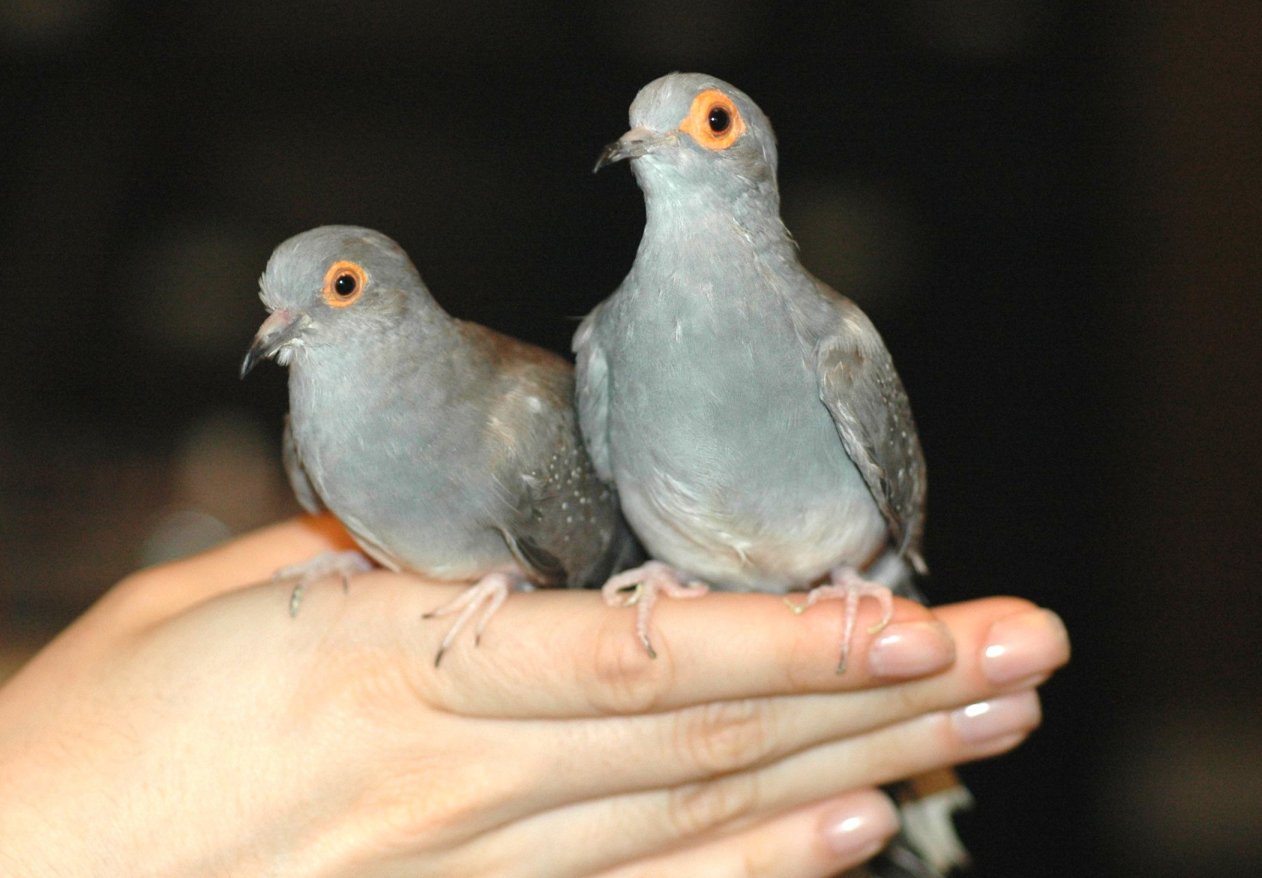
India and Peep
Hatched 2000 and 1998
Photo taken 2005
Page Contents
Routines
Taming Diamond Doves
What You Can Expect From Tame Doves
Human-Dove Bonding
Bonding With a Single Male
Bonding With a Single Female
Diamond Dove Calls
Exchanging Coos With Your Doves
Mating
Mating for Life
When You Do Not Want Any More Baby Birds
When Two Females Become Bonded on Each Other
Introducing New Birds
Replacing One of the Doves of a Pair
Providing a Mate for a Dove After it was Bonded on a Human
Agitated Doves
Fighting
How to Catch a Dove and Return it to it's Cage
Molting
Washing Doves
Clipping Wing Feathers
Lost Tail Feathers
Doves Lost in a Home
Doves Lost Outside the Home
Traveling With Doves
Leaving Your Doves With Others
References
This page
includes items that people often encounter when
living with doves in their home. It was added in 2004 in
response to questions that many people wrote in about that were not included in
the other pages These paragraphs are
based primarily on my personal experiences with my diamonds as well as ringnecks,
zebras, and a few wild doves If you refer to the references listed,
you may find other (different) information about these same subjects.
Life With a Flock of
Diamond Doves After finding our first dove in our back yard, we purchased three more and thus started
with two pairs. By the end of the first year we had several new pairs and
their babies. By that time they were well used to us and a few of the birds
were quite tame. Of course all the adults were busy incubating their eggs or
raising their babies and that did not leave much time to interact with
humans. However all of the birds had learned how to communicate with us if
they felt their needs were not being provided for. Lack of seed or water
would result in intensive cage rattling or in some cases pantomiming the
pecking of seeds or drinking of water. If the water was stale, then the
birds would fill the water bowl with all the rubbish laying around on the
floor of their cage. If the paper towels on the floor had not been changed
recently they would be ripped up in disgust. And if all else failed, they
would put the strips of towel in the water cup leaving the edges hanging out
so the remaining water in the cup would be siphoned out on to the cage
floor. And of course if a human approached the cage their face would quickly
turn red, and in a blink of the eye the cage would be cleaned, new floor
paper would be put down, and new seed, water, and grit would be provided.
And the diamonds would walk around with smug little smiles on their beaks.
The motto of that part of the story is watch your birds carefully when you
are around them. They will try to communicate in many ways - gently at first
and later with more vigor. One of the ways that we used to start to obtain a closer relationship
with the doves was to offer treats at my desk when part of the doves were
given free flight time in the evening. Even though my desk was across the
room from where the cages were located, all of the doves knew some doves
were getting something good to eat. So I would open some cage doors and soon
there were a small flock on my desk snacking on a half slice of wheat bread.
Later when they were satisfied some would fly back to their cages and others
would roll their wings under them and sit under the warmth of the desk lamp
where they would stay until it was time for lights out. Since I was sitting
at the desk working on the computer most of the time, the birds became used
to being close to me. And if they wanted me to do something for them they
learned to walk over to the keyboard and get between me and the monitor to
get my attention. Of course it was not always easy to figure what they
wanted. It could be a nail that was too long or a toe had hardened
poop on it, or their beak needed trimming, or perhaps they had gotten some hair
wrapped around their feet. To avoid problems between a male and a female incubating eggs, I did not open the doors of
these cages, because if a male
leaves the cage, the female may become angry and attack him when he returns. From my observations, I believe it is important to doves to have fixed routines in their lives.
This is easy to see as they will express frustration when their routine is
broken. For
example if they are given free flight time in the evenings and one evening I
am too busy for them, then they will pace back and forth in their cages while giving
me the evil eye.. They learn when to expect their cage to be cleaned, when their
water cup will be refilled, and when they will get a new seed supply. They expect their lights to go on and off at the same time every day.
If they are allowed out of their cages in the evening, then they will expect
to be allowed out every evening. If you create a routine and then
disregard it, they may well find a way to take revenge on you. This example related to some visiting larger doves rather than diamonds. On occasion I have provided treats
of bread, string cheese, noodles, and other foods at my desk. But it
was not long before they determined that these treats should be given every
day in the evening. Soon the flock would arrive at my desk every
evening looking for a treat. If I did not respond by coming up with
something for them, they would pace back and forth across my desk. They quickly learned the sure way not to be ignored was to start walking
back and forth across the keyboard. So their treats quickly became a
routine handout. But they had to develop a new strategy if I
was not at the desk and the computer was turned off. And that
consisted of rearranging the loose papers on the desk, threatening to tear sheets out of
my calendar, and if all else failed then they took to dumping papers and other objects on
the floor. While all this can be funny to a human, to
the birds it is very serious. So to avoid stress in their life, it is
best to keep to a set routine for normal activities and not to invent new
activities that will be later taken as a routine when that was not your
intention.Routine
s
Status Quo
There is nothing that will upset birds than making changes in their environment. The worst thing you can do is to move from one house to another. That is almost as bad as moving from a breeder's aviary or a pet store cage into your home. The next worst thing is moving cages and furniture around even if it is only temporary. In most cases this will cause doves sitting on eggs to abandon their nests. If the move was only temporary they may get back on their eggs once everything has been restored. If the move is for several days - say the time necessary to paint a room then the eggs may be permanently abandoned. I had a pair of doves that had a nest box outside the cage. When I moved the nest box across the living room and placed it on top of a book case, they never went back. As I proceeded to move all the bird cages across the room to expose a wall where some repairs were to be made, they flew round and round looking for their familiar perches. In the end one and then the other of the two birds landed on my head.
Vacations and long vehicle trips are also a problem though strangely enough my experience has been that while the birds do not like traveling by car, they are not that upset about it (with one exception). And when we arrive at a destination and are able to set their cage up near a warm, sun lit window they actually seem happy. However there are sometimes problems. We took one little diamond dove hen who was a real pet on an 800 mile trip and then after a few days the return trip. This bird did not like the view from the widows, and unless being held wanted to stay on the floor of the van we had rented. While traveling the bird did not eat. A few days after our return home, the bird died. My conclusion is that while most doves will travel well by far, there are a few that will not.
We have had a little experience with traveling with doves by airplane but in this case a ringneck dove was involved. The bird did not seem to mind the trip at all and amused himself by doing bow coos at the inside of his carrier. Although it was against the rules the bird was taken out of the carrier and hugged to quiet him. I don't know what would have happened if he went flying while flying...
To tame a diamond dove I feel the best place to start is in a small room that only has a few places where a bird can land and all these places can easily be reached. The smaller the room the better, as the bird will have to fly slower and he will get tired faster. Bathrooms are usually suitable although the mirror should be covered as well as any windows. I then take the cage with a single bird into the bathroom, close the door, and let the bird out of the cage. Usually the bird will fly around, become tired and then land. Put your finger under his chest to try to get him to hop up on it. He will probably fly away. Keep trying, always moving slowly, and eventually he will not want to fly any more and will perch on your finger. Try to bring him close to your face, continually turning him to maintain eye contact and talk to him in low soothing tones. If he flies away repeat the process. Once he stays on your finger for several minutes you may try rewarding him with a soft piece if bread or other treat. He might also appreciate a sip of water if he has spent much time flying.
You may want to try this for somewhere around 10 minutes a day. Try to do it the same time every day for a few weeks so the bird will expect to be spending that time with you. I would suggest postponing taming if you can not spend ten minutes every day with the bird for two weeks or more. An irregular schedule will make the bird wonder what you are trying to do.
Another part of getting the bird to trust you is to keep him near you as much as possible. At first I would get a small cage (not his normal living cage as you do not want to more that one around. His living cage is a home and he expects it to stay in the same place all the time. If you you work at a desk or on a computer, you can place the cage near you. From time to time you can offer treats. You may have a water container in the cage but seeds are not necessary and may result in a mess on your desk.
Then finally work up to the point where you can take the bird out of his cage and put him on a desk lamp that has an arm that will serve as a perch. Our first diamond dove sat with me every night for about five months while I was doing homework for a night course I was taking at the time. She was quiet and slept most of the time, but at around 11 pm she would coo, and that was the signal that she wanted some food and water and wanted to go back to her cage for the night. I would take her to the kitchen and put her on the side of the sink while I got some seed out of the refrigerator and put it in my hand. Then she would fly to my hand to eat the seed.
Some people say that you can quickly tame a dove by feeding it all of its food by hand. But since doves are not the fastest eaters this could be a time consuming process which might require feeding your bird twice a day for a couple of weeks and then from time too time continuing the process after the bird was tamed.
Whatever arrangements you make to keep the bird close to you, remember the process takes time. The bird need to develop a high level of trust in order not to be frightened by you and the things you do.
What you can Expect From Tame DovesIn time birds learn to really care for the person who is taking care of them. For example if you allow your doves out of their cage and then lay down to take a nap, they will become concerned as if they feel you were hurt or ill and may come and land on you and often sit there until you wake up. I have one dove that lands on me and actually goes to sleep herself, but if I sleep for more than an hour she walks up to my face and starts pecking at my lips or sometimes my ears in an attempt to wake me up. And of course she does just that.
Once I was in the kitchen doing something behind the refrigerator and I fell with a loud bang. The male dove that was out at the time flew to me in a flash and landed on my wrist while I was still on the floor, and looked into my face to see if I was all right.
If you only keep a single dove then after a period of time the bird will probably bond on you. Doves are very social and thus have a need to be close to a living being. Indication that bonding has taken place are wing flicking and kissing. If the dove shakes its wings when you approach and kisses (light, rapid pecking) your fingers and face when given the opportunity, then bonding has taken place.
Bonding is usually sexual in nature. If you have bonded with a male, the bird will make bow-coos for objects that belong to you. Sometimes a male will do a bow coo for your fist and then mount your fist and mate with it as if it were a female. Males can get loud with their bow coos, but if the dove finds a nesting site he may sit down for a while and do two notes nesting coos which are much quieter than bow coos.
If you have bonded with a female, she will soon be stimulated enough to lay eggs. Thus you should provide her with a nest and nesting material and allow her to incubate these infertile eggs for the full term (14 days for diamonds, mourning doves, or ringnecks). It is better to allow full term incubation because if you remove the eggs then she will lay another clutch in a few days. Such a regime is not compatible with the hen's long term health. A hen that lays eggs every four or five ways will end up with a low level of calcium in her body and then may suffer from brittle bones and fractures. If she incubates the eggs for 14 days and a few more, and then gets off her nest and rests for a week or so she will only be laying a new clutch once every three weeks which is about what she would do in the wild.
I purchased a male ringneck dove for my older niece in 1991 and after six months or the ringneck was bonded on her and became quite affectionate with her. Of course he would do loud bow coos for everything she owned. Within a year he was flying to her on command. An interesting aspect of this relationship was that if my two nieces were fighting with each other, he would come in defense of my older niece and start attacking my youngest niece. But normally he got along well with everyone in the family.
This dove was quite content to go with my niece when she went out of state four years to go to school and later to travel with her when she was in the Air Force and after that several work locations. Now at an age of 18 years he is back with me because her husband keeps dogs in their house. And he is more affectionate than ever.
Bonding with a female dove is considerably more complicated than bonding with a male dove. But you may find females to be quieter and somewhat more affectionate than male doves. As mentioned above, once a female is bonded she will lay eggs and to maintain her health she needs to incubate each clutch of eggs for the full term (14 days in the case of diamond doves) plus a number of additional days if possible.
I have been bonded to a female dove for ten years so I will use that example to describe the process. My dove as gone through three stages which are outlined below:
STAGE 1: was given this bird at an age of six months. I allowed her out of her cage every evening and at first she explored the carpet looking for spilled seeds. I made no attempt to get acquainted with her but her owner had hand raised her when she was a baby so she was not at all wild. After a few weeks she started coming to my desk to share my supper. Soon she spent all her out-of-cage time sitting on my desk next to the computer keyboard. I started picking her up to pet and hug her. Later I could call her with a long distance coo and hold my palm up and she would fly to me landing in my hand. And if I was away from my desk for too long she would call and if I did not answer she would come looking for me. This bird, like many, liked to be hugged. If something bad happened during her day (like a stranger came to visit me), she would need long consolation hugs as visitors would always upset her. If another bird or human disturbed her, the immediate response would be to fly to the top of my head. A sure sign she wanted me to hold her against my face. At first she demonstrated her affection toward me by flicking her wings and kissing my hands, face, and even my feet
STAGE 2: After about two months she laid two eggs in the bottom of her cage. So I supplied a nest box and nesting material and moved the eggs into the nest. She soon flew to the nest and started incubating the eggs. Then for the next eight years she laid a new clutch of infertile eggs about once a month during all seasons. Soon after she started laying eggs I found it expedient to take her off her eggs once every six hours. I would take her to the bathroom, hold her over the toilet, and wait until she dropped the large stool she had been accumulating. Then I took her back to the bird table and provided her with food an water. When she finished eating, she would return to the eggs on her own. She would wait for me to come and take her off the nest as she would have waited for her mate to come and relieve her. If I was not home, she would only get off the nest on her own several hours after the usual six hours had passed Consider the most wild doves will sit on their nest all night without ever expelling their feces. I should not that birds that have been sitting on a nest holding their feces in for six hours or more will not be able to expel their stool without some effort. To help this bird drop her load I had her fly from one hand to another three times before holding her over the toilet. Another bird that I took to the toilet after she had been sitting on eggs for several hours felt she needed to fly from my hand held at knee height to the top of the light fixture over the mirror. A third bird was different yet and went as soon as I held her over the toilet.
After the fourteen day normal incubation period passed she would stay on the eggs another three or four days and then she would leave the nest. A day later I would remove the eggs, the nesting material, and replace it with new material. For a week she would go back to her old routine of sitting on my desk or on a folded comforter on the sofa and sharing my meals. Then she would start flying around apparently looking for a new nest site. Eventually she would start sitting in these nest sites doing nest coos, begging me to come and pet her. This went on for a few days and then she would go back in her cage and sit in her nest and by the evening of the day she returned to her nest she would have her first egg. She would leave the nest for another 24 hours and then return to it to lay the second egg and start incubation. Eventually I found I could give her treats and sips of water while she was in the nest and she learned that if she was thirsty or hungry she could call me to come and get something for her.
The question many people have concerning this stage, is whether or not a dove hen can maintain her health while having eggs year around for much of her life. In the wild dove that live in the temperate zone usually stop having eggs in the fall when the days grow shorter and the temperatures become cooler. Breeders will simulate this fall and winter period by separating the males and the females for a six month period. But Dr. Wilmer J. Miller found that ringneck doves he used for research could produce eggs every month, year around, up to age 15 or so. He had one hen that produced an average of one offspring per month for the first 18 years of her life (221 babies) and then lived to an age of 27 years. Dr. Miller maintained that this can be done by insuring the dove has the proper food, vitamins, and minerals including trace elements. It is very important that doves that produce eggs in this way maintain proper calcium levels. This can be insured by including foods that contain calcium and providing vitamin D3 to facilitate the absorption of calcium. For more information about the proper foods see the "Caring for Diamonds" page of this web site and the section on foods. Low calcium levels can result in dwarf eggs, soft eggs, thin shelled egg, and egg bound hens The leaching of calcium from the bird's bones, can also cause bone fractures.
STAGE 3: My dove kept producing two eggs a month through her eighth year. Then she produced about one egg per month for a little over another year, and then started producing a single egg on an irregular basis and finally she completely stopped laying eggs. She remains affectionate but a little less so than she was when she was younger. She still complains when I pick up and hold another dove. She will be ten years old in the spring of 2010 and hopefully will live many more years in the future.
In conclusion I feel this is the best way to keep a female dove that is bonded on a human. This way the dove chooses what she wants to do and feels very happy about the arrangement. If I was to somehow separate her from me so she would not be stimulated for say six months each year, she would be very unhappy. I believe if one is to keep a bird in captivity as a pet, then the bird's happiness should have the highest priority.
Maintaining the Relationship With a Bonded Dove
Like any relationship, one has to work at maintaining it if it is to last. With a single dove, it is necessary to pay more attention to your dove's psychological needs as she or he has no one else to turn to if you are not being nice to him or her. When you come in from being out for any period time go to his or her cage and greet him or her. If possible take him or her out of the cage and give him or her a hug. When you are about to leave for some time just before you go out try to express the fact to the bird that you are leaving. Make an attempt to learn some of the dove's language and learn to imitate it. This is not just the normal coos that you usually hear, but the almost inaudible sounds a male and female dove use to communicate when they are sitting beside each other. Bonded doves will greet you when they first see you in the morning and they may even expect a hug at that time. You might want to give your dove a treat in the evening just before you turn the lights out and go to bed. During the day if you are at home, a bonded dove would like to be allowed out of their cage so it can be near you. Many people that keep companion doves do not keep their doves in a cage at all, but I believe for safety's sake you should always put your dove in their cage and fasten the door before you go out.
After we had the birds a year they also became pretty noisy. As the sun comes up in the morning they start cooing as if they wanted to be sure the birds who lived on the other side of the mountain were still there. They do make a good alarm clock if you sleep nearby. Usually they will become quieter later in the day, but it is easy to get them started again if you can imitate their call. The males will also call to persuade their mates to come sit in the nest and there are often times they are ignored, so this monotonous calling seems to go on forever. You can terminate it by putting the female in the nest or by removing the male from it. However the solution is not a permanent one.
These are the different diamond dove calls that my birds make.
- The normal long distance coo (5 notes)
- The answering coo (2 notes)
- Advertising Coo (usually 5 notes and often very loud - males only)
- Conversational coo (2 notes slurred together)
- Nesting Coo (2 notes slurred together along with wing shaking, done from an existing nest or what they perceive to a likely nest site. Usually done by the male but also done by the female)
- Alarm coo (one or more sharp little single note coos when something unusual has happened - like a door opening in another room or another strange sound of some kind).
- Bow Coo (loud single notes down while bowing and fanning the tail by males only)
- Affectionate coo (very quiet raspy coo used between members of a pair) used when arriving or departing, or for other conversation.
- The custom coo - a special coo taught to one or more doves by their owner - we taught one of our males an eight note coo back in the late 1980's and he is now our oldest bird and he still uses this unique coo. The other birds respond to him using the normal five note or two note coos.
Exchanging Coos With Your Doves
One thing it is interesting to do is to learn the various coos used by the diamonds and imitate them. First I would try cooing from another room where they could not see you. When I learned the long distance coo well enough to get a response, then I would go in the room where the cages were so they knew I was cooing at them and not another dove.. Since they were already familiar with my coos by then, they would answer me even when they could see the coos were not coming from another bird. Soon I could get at least one bird to hold a long conversation with me in five note and two note coos.
Sometimes if I went into the room with the birds cage on a quiet afternoon and cooed the normal five note coo it would seem that all the birds would answer in unison if not on the same pitch then be quiet until I answered with a two note coo and then they would all respond again. This could go on for a minute or so then they would soon be cooing to each other and no longer waiting for my response. But it can be very impressive to a visitor.
I have also found that the diamonds (and other doves) will respond to the sound of my voice by cooing at me.
People sometimes think that if you put a male and a female dove in a cage they will soon bond on each other, mate, and have babies. While this may happen, it may take some time before the birds decide that they do not have any other options and thus go ahead with their family. The first pair we put together this way took six months before they decided to mate.
Sometimes males can be very selective about who they will choose for mates. Several years ago we had a very handsome male that was living in a baby cage with about six other young birds including several females. He refused to bond with any of them and eventually they all ended up with other mates. Eventually he ended up in a cage by himself doing loud advertising coos much of the time perhaps thinking that some female over the next mountain would hear his calls.
Then finally one of our old pairs raised a beautiful female with big red eyes. He watched her as she grew up and then decided that this was the one and after two years of waiting he finally started his family. He is now seven years old and his mate is five years and they have had a number of successful clutches.
Sometimes we have found that a pair that has been together for some time no longer cuddles at night nor shows any interest in mating and making a nest. The thought might be that they have somehow become incompatible. Recently we had such a pair and allowed them to fly loose for a few days to see what would happen. They established themselves in an open cage that housed two very old birds that spent their time on the cage floor. After a few days they were once again cuddling at night and soon after they took nest material from a nest in another open cage and build themselves a nest in the empty nest box in their new cage. Mating has taken place a few times and now the hen is in the nest.
When such problems are encountered it would seem prudent to either move the existing cage to a new location or provide another cage. The cage these birds selected had somewhat better lighting, was slightly larger, and was lower down providing a view of the other birds that was not available in their old cage.
Mating for LifeThere is a saying the doves mate for life which may be somewhat misleading. They say doves will mate for life unless something occurs that indicates the pair is incompatible or death or injury occurs to one of the pair. In real life that is not completely true. I have had males reject females when the female could not produce eggs and then trade back again when they found themselves incompatible with the second bird.
Once a dove bonds with a human for some time, then it will not want to bond with another bird as longs as the human is present in the home. Also recognize that if you end up hand feeding a baby dove there is a good chance the bird will bond on you and then be unhappy if you provide him or her with a mate. Babies would bond on their parents except that after the babies are three weeks old or so, the parents will usually push them to be independent by being a little mean to them.
When You Do Not Want Any More Baby Birds
Theoretically diamond doves could produce one clutch of two eggs every month this producing 24 doves in one year. In practice only about half of those doves will hatch out and become adult birds. With two pairs you still could end up with 12 pairs and each pair could mate and start laying eggs at about an age of three to four months.. In 1984 we started off with two pairs with the idea that we could then sell babies as unrelated pairs. But the children that were involved with these doves absolutely refused to consider the sale of any of "their" babies. Soon the babies in the baby cage paired off and had babies of their own. Within a few months we had a garage full of primitive home made wooden cages and a multitude of doves. The amount of time it took to add seed and grit to the seed cups in the cages, replace the water, and clean the cages was unbelievable. I would not recommend this scenario for anyone.
However some people do feel their doves can only be really happy if they are allowed to reproduce and thus they spend a considerable amount of effort finding homes for their new babies. Dr. Van Hoozier, the author of the Diamond Dove book, had 15 clutches the first year she had her pair of diamonds. This resulted in 30 eggs out of which 17 babies were produced. She made the effort to find homes for many of her birds and the rest were sold to local pet stores.
Her doves have since produced babies for the past eight years and she has always been able to find someplace for all of the birds that were produced.But many do not have the time or interest to undertake this chore and thus wish to use some method to prevent new babies from being produced while keeping their doves relatively happy.
Some people believe they can just discard the eggs as soon as the parents lay them. But then the hen will lay another clutch within a few days. If this method is followed a hen might lay eight eggs in a month instead of two which will result in the depletion of the birds calcium resources. Low calcium levels can result in dwarf eggs, soft shelled eggs, single eggs, egg binding, and broken bones.
Others hope they will stop egg laying by removing the nest and nesting material from the cage. If this is done chances are the hen will lay her eggs on the cage floor and because she does not have a nest she may or may not incubate the eggs and if not, she will again lay multiple clutches in a given month.
Using Artificial Eggs: One solution to this problem is to encourage the hen to accept artificial or dummy eggs in place of her own eggs so she will incubate them for the full 14 day term plus a few more days. One can do this by providing a nest box and nesting material as usual, and then after the second egg is laid replace both eggs with two dummy eggs. Dummy eggs can be purchased from a store that sells pigeon and dove supplies. But many people just save up old infertile diamond dove eggs that never hatched. Thus it is a good idea to collect such eggs as soon as your doves start to have eggs.. Several readers have reported that purchased eggs do not have to be exact replicas to be accepted by the diamonds. They may accept eggs that are slightly smaller or larger and even eggs that are of a different color, and even eggs that have a pattern on its shell. You should allow/encourage the doves to incubate these eggs until they decide they are not going to hatch. Usually this will take the normal 14 days plus an additional 3 or 4 days. After that they will abandon the nest. At that time the eggs can be removed and saved for the next clutch. Keep in mind the longer they stay on their eggs, the longer it will be before the next clutch is laid, and the healthier the hen will be.
The nest should be cleaned and new nesting material should be provided. Most doves will wait a week or more before starting work on the next clutch.
An additional thought. As time passes, and you may run into someone that would like a baby dove, then you can keep your birds happy by allowing your doves to incubate their real eggs and raise the resulting babies. That may help convince them that they have valid relationship and they do not need to consider breaking up because of the lack babies produced Despite the fact that doves supposedly mate for life, when things go wrong I have seen a pair break up and look for a new mate. On the other hand I have seen a pair that never had any eggs stay together for a very long life.
When Two Females Become Bonded on Each Other
If there are not enough males to go around, two females will often bond on each other and then look for a nest site and nesting material. Once they have constructed a nest with the materials on hand, they will both lay two infertile eggs, and proceed to incubate them for the usual 14 day period plus 3 or 4 more days.
The problem occurs when the doves' owner decides to take away the "useless" infertile eggs rather leaving the hens to incubate them for two weeks. In a few days the hens will lay another clutch and so on and then low calcium levels will result as will the risk of small eggs, soft shelled eggs, egg binding, and bone fractures.
To avoid these problems one should always place a nest in a cage where two bonded females are kept. Some nesting material should be placed in the nest and additional material should be placed on the cage floor. And the two hens should be allowed (encouraged) to incubate their eggs for the full term of 14 days plus a few more. There eggs can be removed a day or so after they have abandoned the nest
This section pertains to bringing new birds home that either will be house in separate cages or young birds which may be housed in a baby cage until they are older. The main consideration is the need for quarantine to protect you existing birds, the need for a stress reduction period, and an acquaintance period if new birds are to be installed in a cage with old birds.
1. Keep the new birds in a separate cage at some distance or preferably in a separate room from where the existing birds are located for one or perhaps two weeks. This is a quarantine period. Observe the birds for any evidence of disease during this time. When cleaning bird cage or feeding the birds, always feed or clean the old birds first and then clean the new bird cages).
It is important to treat the quarantine period seriously. I heard of someone that purchased a number of doves at a large well known dove show, brought them home, and did not quarantine them. Not only did he loose the birds he purchased that looked very fine at the bird show, but he also lost most of his original flock.
2. Also consider this as a stress reduction period, as moving a bird always causes a high level of stress. Have the bird's cage ready before you return home. And then for the first week or two, only have one person approach the cage to provide food, water, and grit. Be sure the cage is located in a warm, quiet, draft free area where there is little human or other pet traffic. Also be sure no one approaches the cage wearing bright colored clothing, especially reds, yellows and oranges. Also be careful about carrying large objects near the bird's cage. Something as benign as a guitar case can cause havoc.
3. Installing new birds in the same cage with old birds almost always causes problems. New birds will be considered intruders by the old birds and this may result in fighting.
Replacing One of the Doves of a Pair
Normally finding a new mate for a dove that has lost its mate can be a rather long and complicated process. This is the method I normally recommend.. But you may wish to take a shortcut and forgo the quarantine, stress reduction, and acquaintance periods described below. By doing so you would be taking some health risks and fighting could develop. If it fighting does occur, it usually is because the old bird perceives the new bird as an intruder. In that case I would suggest that you back up and follow the method below, modifying it as you see fit. The worst aspect of it is that you will need two cages but one can be used as a baby cage later.
1. Purchase a dove of the appropriate sex that is at least four months old. Be sure you obtain a bird of the correct sex. See the section on sexing diamond doves on this web site. Remember it is almost impossible to sex young birds and many pet store owners do not know how to sex diamond doves.
2. Keep the bird in a separate cage at some distance from the original bird and any other birds you may have for one or possibly two weeks. Consider this a quarantine period.
3. Also consider this a stress reduction period as moving a bird always causes a high level of stress. Have the bird's cage ready before you return home with the bird and then for the first week only have one person approach the cage to provide food, water, and grit. Be sure the cage is located in a warm, quiet, draft free where there is little human or other pet traffic. Also be sure no one approaches the cage wearing bright colored clothing, especially reds, yellows and oranges. Be careful about carrying large objects near the bird's cage. Something as benign as a guitar case can cause havoc.
4. After one or two weeks, if the new bird appears healthy and appears to be relatively calm, then place the cages together for another week or more and observe the interaction between the two birds. If the male does bow coos toward the female and she acts interested then you can do one of the following:
5a. Allow both birds out of their cages in a closed room with windows and mirrors covered and watch their interaction. If the male follows the female, does bow coos, mounts her, and mates then they should be returned to the cage of the new birds, not the cage of the old bird. This should eliminate the possibility of the old bird feeling ownership of his or her cage and then treating the new bird as an intruder. If there is fighting of any kind then return the birds to their original cages, and continue these trial flights another day and keep repeating the process until they are able to live together without fighting. Have a nest box and nesting material ready for installation in their cage once they get along together inside the cage.
5b. Instead of allowing the birds out of their cages to get aquatinted, move the old bird into the new bird's cage and carefully observe the interaction between them. If fighting occurs then separate them and try again another day. Repeat as many times as necessary.
A good indication that bonding has taken place is that at night the two birds will perch together and cuddle. Bow coos and even mating may not indicate a fully bonded pair. Males will do bow coos for any bird and sometime females will crouch and accept a male's mounting before she really develops a strong feeling for him.
Providing a Mate for a Dove After it was Bonded on a Human
Information I have about this process is in most cases it really does not work unless the human is no longer in the home. Many people that write in have kept a single dove for a number of years feel that their bird has become lonely and they want to find a mate for it. Doves usually do not divorce their mate unless it dies or has somehow was lost, no matter if it is a bird of the opposite sex, a bird of the same sex, or a human. Perhaps the males will play around a little but they always seem to return home to their mate in the end. On the other hand I have never seen a female play around with other males. So my advice, if you think your dove is lonely, try to spend more quality time with him or her or at least give the bird the option of sitting with or on you while you are watching television, working at a computer, or reading a book. If you do not have the time to spend with the bird the only other solution might be to give the bird to someone else who has a bird with which it might mate, but don’t think about bring the new pair back to your home as your old bird will be torn between showing affection for his or her new mate and you.
Agitated Doves
Many things can cause doves to be agitated and to give the caretaker the impression that the birds are very wild when in reality there are certain things in the environment that can frighten the bird and once the item is removed the birds will be calm.
Visitors
Doves quickly learn to recognize their owner and eventually become quite comfortable having them place additional seed in the seed cup, change the water, attach a new cuttlebone to the cage, and perform other chores necessary for the doves' welfare. But they are always suspicious when there is something new in their environment. However, if a pet that they are not accustom to seeing or a human visitor enters their room, then the doves will often end up thrashing about their cage doing considerable damage to their wing feathers and perhaps even damage to their body, particularly their head.
To minimize the problem of a visitor, one answer I have found helpful when maintenance people or a bug-man enters the room, is to stand near the bird's cages and talk or coo to them. Ask the visitor not to talk loudly, not make any sudden or quick movements, and while the birds will remain tense they may not flutter around violently. If the visitor is carrying an object, like a tool box, it would be best if he kept it low and behind his body as much as possible.
When my niece comes over with her guitar case she has learned to carry it low, behind her, and to make no sudden movements with it.
Breeders who keep large numbers of birds often wear a lab coat when they are working with their birds so they appear the same every day. And when they have visitors they keep an extra lab coat for them. I do not go to this extreme, but I have learned to wear clothing that appears the same when I am cleaning cages and to stay away from the cages when I have strange clothing on and I am wearing dark glasses.
Bright Colored Clothing
Another reason for using a lab coat is to cover up bright colored clothing. If you or a visitor wears pink, red, or yellow clothing the birds may probably go absolutely wild. When my niece comes over wearing such clothing we have learned that she needs to find some suitable garment that I have in my closet that will cover up the offending colors.
Other Pets
Other pets, particularly cats and dogs can be a problem if your are keeping doves. And other birds can also be a problem. Recognize that just because you dove is locked in his or her cage she may not necessarily be safe. People have written me concerning the ability of cats to kill a bird without even opening a cage. And then some cats are smart enough to open some cages.
Often people believe their dog or cat does not pay any attention to their dove bad has no interest in harming their bird. Then one day the bird is out while they are cleaning the cage. A dog will often grab a bird walking on a carpet and bring the bird, now injured or killed, to you. A cat may be quite happy just to kill and eat the bird.
I often have the problem of visitor's bringing their dog or cat or bird in when they come to visit. My first reaction is to return all birds to their cages and then to shut all cage doors, even those that I normally leave open. If a cat or kitten is brought in to my apartment I insist that they are either held at all times or they are shut in the bedroom. If someone brings in a parrot of any species, I also feel that my doves need to be confined to locked cages. And these birds need to be watched as some, like lovebirds, have the ability to open cages.
One also has to be aware of roaming cats outside that become aware that you keep birds inside. I have had a cat climb up on my window ledge, even when the window was closed, and terrorize my doves as their cages are near a window.
I had another episode where a neighbor's cat learned that I had birds inside and one day waited in the open garage and went into the house while I was getting ready to leave. I never saw her. An hour later when I returned home a found the cat in our den trying to make high leaps to the top of the book case where our birds were kept at that time. The birds were going crazy, thrashing about inside their cages, breaking their wing and tail feathers. I grabbed the cat, none to gently, and she tore out of my hands and leaped out the open window breaking a hole in the screen!
In closing this section let me mention that I have received many tragic messages from people who lost their doves as the result have not being very careful about protecting their doves from other pets.
Night Frights
If you sleep far away from your birds so you can not hear them at night and then notice broken wing feathers and blood on the head and body, you may be having "night frights". This happens when the bird is sleeping in a very dark environment and is frightened by some kind of noise or movement. In the wild when a bird roosting in a tree or bush is frightened he will fly upward as fast as he can. I can remember one mourning when I was walking to work before it was light and I passed close to a large leafy shrub and brushed the branches, the shrub seem to explode with whirring mourning doves flying mostly upward but also toward a nearby street light. Of course if caged doves try that feat they will surely hurt themselves as they thrash against the cage bars.
The solution as mentioned elsewhere on this site is to provide a night light of sufficient intensity that allows them to see their surroundings but is not so strong as to not permit them to sleep. I use a 40 watt desk lamp on the far side of the room but many solutions are possible.
Attempts at Communication
Doves will often bang about their cage, flying from perch to perch, perch to nest, or perch to seed cup, shaking their cage and making quite a bid of noise in order to attract the owner's attention so he can resolve something that the doves perceive as a problem. The source of their concern may be the lack of seed in a seed cup, an empty or dirty water cup, the lack for nesting material, some problem with the nest, or perhaps a baby that accidentally fell out of the nest (though they can usually resolve that problem themselves). Solve the problem and there will be peace and quiet.
Desire to get out and fly
Sometimes you will observe one of a pair doves, usually the male, flying in place in the center of the cage. My experience has been that he is trying to tell you he needs to get out and do some real flying. And once I open the cage door, the dove zooms out, and picks up speed and circles the living room several times and perches on top of a cage panting like he was permanently exhausted. If his mate is not incubating eggs or sitting on the baby she will usually come out and join him. And sometimes they will chase each other from landing point to landing point.
If the female does come out when she has eggs or babies, she will soon return to the cage and nest on her own accord and the male will soon follow.
Before letting birds out for free flight, be sure all the doors in the room are closed, mirrors and windows are covered, and other pets have been removed from the room.
Parents Attacking Babies
By the time babies are three weeks old, they are usually eating seed on their own and have mastered the fundamentals of flight and are ready to move on. But often they continue to beg their parents for food and at night they enjoy cuddling with their father as the mother has probably already laid her next clutch and is incubating her new eggs. Eventually the parents find it difficult to endure large babies, flapping their wings in the parents' faces, when they can just as well eat on their own. This is usually when the parents start to attack the babies and it is when they need to be removed from the parent's cage before any harm is done. It should be said that we have had some babies that were smart enough not to beg for food and these babies have stayed with their parents four weeks or more often helping to incubate the new eggs. Eventually they get bored and want to go off on their own.
Aggressive Males
Two males living together may be a problem some or all of the time. I have two male zebra doves which are quite affectionate toward each other most of the time. But eventually they will start doing bow coos toward each other and usually this ends with a mutual attack requiring the doves to be separated for several hours or perhaps the rest of the day. By nightfall they will go back together and cuddle like a male and female pair for the night.
Sometimes males will attack females if they want to mate and the female is not interested. Often these attacks become serious enough that the two birds must be separated.
A male will often attack a female if he perceives that she is not doing her duty of incubating the eggs or taking care of the young. Usually a short term separation is all that is necessary to correct this situation.
See the section below for additional information about problems with male doves.
Fighting among doves is rare but when it does occur it can easily result in serious wounds, particularly around the head and eyes. There are many reasons for doves fighting and they are listed below. But before you worry much about the cause, the birds need to be separated, perhaps by letting one out of the cage and keeping the other in for a short time or the rest of the day. However if the fighting continues after the birds are returned together then a longer separation and a second cage is required
Unpaired Doves
Placing two males together may or may not result in fighting. Males tend to be territorial only when they have mates and when incubation is underway. If fighting between two males housed together does occur probably the only solution would be to separate them permanently.
One also has to be careful during periods of free flight as sometimes males will develop a certain level of animosity toward other males and severe fighting will occur. I have three males that cannot be let out at the same time and one of these can never be let out with any other male or he will be attacked. This is our only single male at the present but it may also be a result of the fact that this male, when younger, tried to mate with every male he encountered.
Single females rarely fight and in fact I have never observed such fighting except when they managed to have eggs and were involved in incubation and then they are an absolute terror. I have seen diamond hens attack a much larger bird such as a ringneck that intruded into their space.
Here are some reasons males will attack females and females will attack males.
Paired Doves
Males attacking females
- The female refuses to allow mating.
- The female will not incubate the eggs
- The female will not feed her babies
Females attacking males
- The male is not providing nesting material
- There is no food or water in the cage
- The male will not relieve the female during egg incubation
- The male leaves the cage when the female is incubating eggs or keeping the babies warm.
If the cause of the fighting can be determined and it can be resolved by putting additional seed, clean water, grit, a new cuttlebone, or nesting material in the cage then the fighting will stop immediately. In cases where the cause can not be determined or when a high level of anger has developed, I usually let one or both birds out so they can fly around (usually at very high speeds) until they tire themselves sufficient to forget their problem. Usually within ten to thirty minutes they will be ready to return to their cage and will cuddle and make up.
However sometimes the two birds will have to be separated. Often we will leave one, usually the female, in their cage and put the male in a baby cage until night and then return the male just after the lights go out. They usually will not fight in the dark but they should be watched in the morning. Other times separation has been required for several days.
We had one pair where the male absolutely refused to sit on the nest. The female put up with this unusual behavior for two years even though it was obvious that she was unhappy. Then in the third year she attacked the male viciously. We would put him on the nest but he would just get off and the fighting would begin again. So we separated the two for the rest of the day and returned them together at night. The next morning the fighting would begin again. So they were separated for a longer period of time which ended by being weeks while the female raised their babies on her own. The male was returned after the babies had left the parents cage and they made up and mated and the female laid her two eggs. And once again the fighting started. This went on for two years and finally the female became resigned to the fact that her mate would never sit on the nest and they lived happily (?) ever after.
How to Catch Doves and Return Them to Their Cage
If you are going to let out doves to free fly, recognize that it may take some time to catch a non cooperating dove and put him or her back in his cage. The method is simple - walk calmly toward the dove and attempt to pick him up by putting your finger under his chest and lifting. Unless the dove has already been tamed, it will fly away and eventually land somewhere else. Walk calmly (do not hurry) toward the dove and again attempt to pick him up using your finger under his chest. He will again fly. Continue this effort until the dove becomes tired and does hop up on your finger and then take him back to the cage. It will take time to reach the point where he is too tired to continue to fly, but take care not to frighten him by hurrying too fast, or he will find extra strength and prolong the process. If the bird starts flying very rapidly and is panting between flights it would be best to leave alone and try again a little later.
If you are running out of patience, then a faster alternative is to darken the room by pulling curtains across windows and turning off lights to the point where you can just see the bird yourself. Then you should be able to pick up the bird if you do not use any sudden movements. However, if the bird does become scared and flies in the dark, you should turn one light back on until the bird lands. Then you can turn the light off and repeat the process
Molting
All doves molt periodically. The time of molting depends on the climate and/or the season. My diamonds usually have a heavy molt in the fall and then a light molt in the spring. Of course my doves are kept inside and may not have much of an indication of changes in day length, but they surely are aware of temperature differences between seasons. In the summer the temperatures in my apartment ranges between 85 and 90 F. and in the winter range between 48 and 80 F.
The molt starts with the ten primary flight feathers on each wing. New feathers start to grow in and then after they are about 3/4 normal length, the old feathers drop out. The old feathers drop out in small groups on each side so as to not interfere with flight capabilities.
Once the primary feathers have been replaced, the molt of the secondaries follow. There are 11 to 15 secondary feathers on each wing. Not all are molted in one year - sometimes only three are molted, but in some years all are molted at the same time
The tail feathers are molted at the same time as the secondary feathers. Diamonds have 12 tail feathers. The first molted are those in the center and the last molted are the outside feathers. By the time the outside feathers are molted the new middle feathers are almost full grown.
Body feathers are molted at the same time as these last two groups and sometimes bald patches occur as the result of this part of the molt.
Down feathers can be molted at most any time of the year but usually will be quickly replaced as the weather gets colder in the fall.
Baby doves molt a few weeks after fledging. Diamonds usually fledge at about 12 to 14 days and then according to Vriends will start their first molt will be two weeks later or about the second month of their lives. This molt will go on for 35 days or so.
Washing DovesDiamond Doves normal do not bathe in water but through preening they are usually able to keep themselves clean as other birds who do bath in water. Ringnecks and mourning doves do frequently take water baths. With older birds that may not be able to perch, feathers are soiled by a bird getting feces on it underside. Such birds need to be bathed often to avoid destruction of their feathers. I had an old diamond dove that lost most of the use of his legs and he needed to be bathed about every two weeks. Once he got used to it I think he was quite happy to be immersed in warm water for ten minutes although he never like the drying process
The following is the procedure I use when I have to wash doves. When I have needed to clean doves that have some how soiled their feathers I give them a warm water bath, immersing them up to their necks. I use Pantene shampoo (for dry or damaged hair). Other gentle shampoos probably would work just as well. Of course this removes much of the oil from their feathers and they will not be waterproof again for some time. That is not important as long as the bird is kept inside and out of the rain. My older doves are tame enough that they tend to cooperate but some may not - especially the younger ones. Keeping the water temperature warm enough tends to help cooperation. Remember dove body temperature is about 106 degrees F so the bath water needs to be warmer than this. You can give cooperating doves long baths so any dried feces and other dirt can be well soaked and then removed using your hands.
Be sure to rinse the shampoo off the bird using clean warm water before taking him out to dry.
The critical aspect of giving a dove a bath is getting the bird dry after the bath and keeping them warm during the process. In a warm room without drafts, I blot as much water as I can from the bird's body and then use a hair dryer on the bird's feathers until they are perfectly dry. Doves are often frightened by the noise and wind produced by the dryer, but once they realize they are staying warm because of it use they usually stay quiet and allow you to hold their wings away from their bodies and blow dry their wings and the body feather underneath.
Do recognize drying does take a long time. Do not stop drying until the feathers are completely dry. Once the bird is completely dry, its feathers will look beautiful and I am of the opinion that after it is all over the doves are very happy with the result.
I would suggest not beginning this process until you have at least an hour to spare. Once you have the bird in the bath you must devote the time to getting him completely dry.
Once I have finished with the drying process, I usually place the dove in a large cage that has a large 65 watt lamp that produces 110 degrees F on the cage floor. I let the dove stay under the lamp as long as he wants
Clipping Wing Feathers
A number of people have written in and ask about clipping a dove's wing feathers to either completely prevent them from flying or to diminish their flying capabilities. My feeling is that by clipping the feathers of a dove, you are temporarily crippling the dove, particularly because they do not have the ability to climb up certain materials as parrots are able to do with their much stronger breaks. I am 100 percent against removing all capabilities of flight because then the dove will lack the ability to exercise and may eventually become overweight and have other health problems. I am 90 percent against the partial removal of flight capabilities because of the frustration encountered by the dove. Perhaps it can be equated to a human being forced to use a wheel chair to move about. Fortunately clipped feathers will be removed and will grow back in about six months.
Many feel that clipping feathers help in taming a new dove. But taming can be done by using other methods that are described elsewhere on this site. Those methods may take longer but in the meantime you will have a happier bird. You have to realize that one of a bird's biggest joys in life is being able to fly.
Because I am against this procedure I will not include information on how to clip feathers. If you feel you must do this, then I suggest you take the bird to an avian veterinarian.
Lost Tail Feathers
When bird owners try to grab their birds, often their hand will often slide back to the tail feathers. If the owner holds on to these feathers, often he will find himself holding a handful of feathers while the bird has left the vicinity looking more like a quail than a dove. But serious damage has not be done, Doves (and other birds) have the ability to release feathers as necessary to escape the clutches of a predator (or a bird owner). These feathers will all grow back within four to six weeks.
Diamond doves often become "lost" in people's homes if the bird's owner does not keep track of where their birds are when allowed out of the cage. A loose dove that is frightened can easily fly into situations where it can not easily be found and sometimes can get into situations it can not get out of by itself. My birds have gotten behind the books in a book case, on top of the clothes hanging in a clothes closet, crashed into wastepaper baskets they could not get out of, have fallen behind the kitchen stove requiring the stove to be pulled out, and have landed on top of ceiling light fixtures where you would never think of looking for them. One bird even flew under a bed and then up on the cross supports where it could not be easily seen when looking under the bed. And when birds get into dark situations they tend not to move.
I keep a written list of possible locations so I will not overlook anything if I am faced with a lost bird. Then I will "remember" to empty all waste baskets, look on the top of all ceiling light fixtures, pull books out of book cases, and finally pull out the kitchen stove so I can see behind it.
If you coo for the lost bird, sometimes he will answer or at least make some kind of noise to give you a clue as to where he is. Sometimes I take the lost bird's mate around when I am searching for a missing bird. There are times when the bird will hear something I do not hear, and then call and receive an answer.
Just do not give up. Birds do not disappear as you might think after spending hours looking for one. And they are really depending on your rescue!
Doves Lost Outside the Home
If a dove escapes out an open door or window and gets outside, do not assume it is gone forever. Although doves may not want to return inside immediately, by the time it starts to get dark they would really like to be home. The problem is they do not know how to get back inside.
Usually an escaped dove will remain in the vicinity of its home and look for a way to get in. It watches the humans who live there come and go out but it never manages to communicate with them during the short time the bird sees them and if the people exit or enter via a car in an attached garage the problem is even worse.
Once we lost a male diamond who departed through an open garage door. We went out and called and called for it but he did not respond. Then three weeks later, one Saturday morning, the garage door was open and all of us were outside working in the front yard, and here comes a little gray dove calmly walking up the driveway ( I don't know why he was not flying as he was perfectly capable of flight as he later demonstrated). As we stood there watching, the dove walked into the garage so my niece ran inside and closed the door. She put her finger in front of the bird and it hopped up. Amazingly, the bird was much heavier than when it had left. He was then happily reunited with his mate. Afterwards the neighbors told us they had seen the bird flying around outside our house during that three week period that the bird was away. If any of us had spent some time outside during those three weeks we probably would have seen the bird and if we had opened the garage door for a reasonable period of time he probably would have come inside.
Here is another story about a returned escapee who managed to return although the subject of the story was not a diamond. I received a phone call late one evening in from my youngest niece (age 26) who was crying like a small child. She had taken her Quaker parrot with clipped wings outside while she was cleaning her bird cages. Since her wings were clipped, she did not believe the bird could fly as it definitely did not fly in the house. But like a helicopter, hover climbs in still air require a considerable amount of power. However given a headwind and terrain that allows a gradual increase in altitude, a climb can be made using much less power. Thus the parrot headed into the wind and found it did not take much effort to take off and eventually reached the tops of the highest trees in the neighborhood much to my niece's amazement.
By then it was getting dark, and despite my niece's calls, the bird showed no signs of making a return flight and was soon lost from sight as the light waned. My niece called me and I told her the bird would soon settle down in the tree tops and would remain there until first light in the morning when she surely would try to return home. I told her to go to bed and be very sure to get up before dawn and then stay outside and watch for the bird so it did not end up on the ground wondering what to do in that cat infested neighborhood where she lives.
The next morning she did get up early but there were no signs of the bird. She continued walking around the outside of the house calling and finally she heard a response but could not see the bird anywhere. The bird talks some so it was then able to screech "COME HERE!!!" It was then obvious that the bird was on the other side of a seven foot fence in the back yard. Apparently, the bird could not fly across the top of the fence in the still morning air and since my niece could not climb the fence, she got in a car and drove around to the street behind and found the bird perched on a small tree branch just higher than her head. She pulled the branch down and the bird jumped to her hand. After it was all over my daughter suggested that I remind readers not to give up if they lose a bird because birds really do want to get home as much as you want to find them. But you have to be outside if you want the bird to make contact with you.
Not all birds do well after leaving their home. Some are so frightened they just fly off and then have no idea how to return to their home. These might be newly purchased birds or birds that are going outside for the first time in their lives. However, sometimes such birds are picked up by others and their return can be assisted by posting notices around the neighborhood or even advertising in a newspaper. And even if they are not returned, they do have a chance of becoming someone else's pet. In fact our first diamond dove was one that someone else lost and happened to wander into our back yard.
Traveling With Doves
Many people feel traveling with doves can be an unpleasant undertaking with the doves shut up in a dark traveling container with considerable stress because they have no idea what is going to happen to them. But with advanced planning and traveling containers that allow the doves to see where they are in the car and that you are there with them, much of this stress can be avoided. I believe it is a good idea to get your doves used to traveling in your vehicle on short trips whenever you have an opportunity. Then when trips must be made to go to a vet office or to visit a friends or perhaps even to take a vacation, the doves will not be as stressed as they might otherwise be. In fact I have taken 200 mile plus trips with my doves and found it quite enjoyable. I usually have the doves in small cages in the back seat of my care and once we get started I usually can get them to coo to me and then to each other. Of course it helps if the weather is good, sunlight is entering the car, and the traffic is light with few big trucks.
We have also taken our doves on a number of commercial aircraft trips without difficulty. Recently we have found that the birds need to be examined by a vet before a trip and be certified to be disease free. We also have been concerned about taking the birds through airport security, Some uninformed security personnel want you to open the birds container not realizing that a stressed bird in that situation might fly away. We have not run into that problem, but one might avoid it by having a container that is transparent so inspectors can see inside without opening it and also so the doves can see outside. Our ringneck dove usually demanded to be let out once we were seated so it could cuddle with us and look out the window which is apparently against regulations. None the less we never had any problems with aircraft personnel or other passengers. However I would think it best that diamonds were not let out for any reason.
A few people wrote in about taking the zebra doves from Hawaii to various points in the continental United States by airplane and none indicated they had a problem with such a long flight but they all were somewhat concerned before they started.
Breeders often send their birds to customers using post office approved containers that allow light to enter the enclosure through small translucent panels. Apparently most doves do well traveling in these special boxes. Two zebras and a diamond were sent to me in this manner and while I was driving the birds home from the post office I tried cooing to the diamond. He finally answered me so I guess he was not that stressed out. I was not familiar with the zebra dove coo at that time so I only cooed with the diamond. I guess the zebras were not stressed with because as soon as the diamond started his conversation with me they let loose with their infamous loud zebra coos.
In conclusion there are many ways to travel with doves in a manner that does not cause high levels of stress. But to do this you should prepare yor doves beforehand by taking them on short pleasant trips so when you really must travel they will be ready for an almost stress free trip.
Often it is difficult to find someone to take care of the birds and even if you do find someone they may not see reason to follow the instructions you provide. Of course if you have a family member or relation that knows birds, then the outcome will usually be more favorable. Over the years I have lost three birds while I was on vacation and have had several birds sustain injuries that would not have happened at home. Even veterinary assistants will often make assumptions about what is right fro your birds based on their experience which may not be appropriate for your birds. For example if one or more birds get out of their cage they may be returned to the wrong cage which will result in fighting. Veterinary workers may not take the care needed to insure your doves are provided with the correct food, sufficient water, and grit or livestock salt with trace elements. And some older birds must be watched for low body temperatures and then there is the need of some to be held to avoid depression.
References
Brown, Danny, "Diamond Dove, Geopelia cuneata", A Guide to Pigeons, Doves & Quail, Their Management, Care & Breeding, South Tweeds Heads, Australia: Australian Birdkeeper 1995, pp. 114-117Gos, Michael W., Doves. Neptune City, NJ: T.F.H. Publications, Inc., 1989, p. 80-84
Naether, Carl A., Diamond Doves" Chapter 7 of Raising Doves and Pigeons. New York: David McKay Company, Inc., 1979, pp. 94-99
Vriends, Matthew M., PhD., Doves, A Complete Pet Owner's Manual. Happauge, NY: Barrons Educational Series, Inc., 1994 , pp. 81-83
Helen White
P. O. Box 367,
Tallahassee, FL 32302-0367
Last revised on: February 19, 2013