|
Welcome to the Diamond Dove Home Page. MAIN MENUDiamond DovesSite Map Diamond doves Acquiring Diamond Doves Caring for Diamonds Living With Diamonds Raising Diamonds Growth of a Diamond Baby One Year's Reproduction Data Tribute to China Other Dove SpeciesOther Geopelia SpeciesRingneck Doves Eurasian Collared Doves Cape Doves Mourning Doves Mourning Dove Baby Growth Rock doves North American Doves Dove Genera of the World All Doves Caring for Injured or Sick DovesTaming Doves Other
Books of Interest LinksInformational SitesAmerican Dove AssociationCommercial SitesJeff Dowining - Diamond DovesGarrie Landry - Diamond Doves Wade Oliver - The Dove Page Doveland Press - Diamond Doves
|
Mourning DoveZenaida macroura
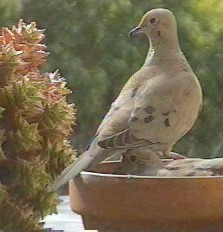
Pair of Mourning Doves on a Los Angeles Balcony Photograph Credits
Photograph above - Gary Friedman, Los Angeles California Page Contents GENERAL INFORMATION
Introduction WHEN DOVES NEED ASSISTANCE
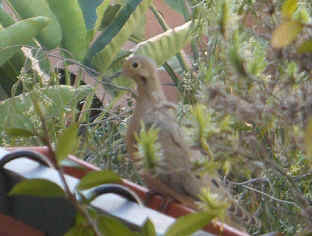
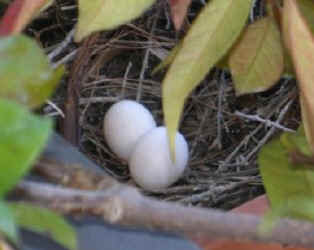
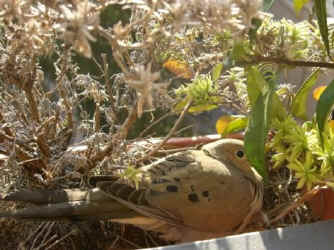
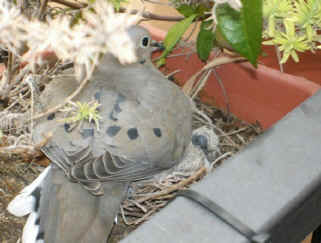
Nesting Problems in Residential Areas IntroductionMourning doves are one of the most common and perhaps most loved of all the doves found in the United States. Their mournful call can be heard throughout the day during the summer months in most states. They are well known for their peaceful and gentle nature. And those who have ended up and rescuing these birds have usually found them to be friendly and if kept some time even, affectionate and loving. Males also have a sense of humor at times. While mourning doves only have an average life of a year and a half, a banded mourning dove has been reported to have reached an age of 31 before dying. It has also been estimated that almost half of the mourning dove population dies each year, but that these doves are so prolific that new babies more than offset the number of doves that die. They are well known because they often choose to build their nests close to, on, or even in human habitations. Many people have found mourning doves building nest on their patios, decks, porches, and even on the balconies of hi rise apartment buildings. There favorite nesting sites are empty flower pots and planters. Several people have reported mourning doves raising their babies inside their garages even when the doors were closed much of the time. One woman ended up leaving her garage window open to allow the dove to enter and leave whenever they wanted. Another man who used his garage as a workshop on a daily basis had a pair of mourning doves come in and build a nest close to his work bench. And finally a woman sent photos in to Gary Friedman link above) showing a dove nested on top of a wreath attached to her front door. That nest precluded the use of the front door for four weeks. People have found that if care is taken to avoid wearing bright colored clothing (any reds or yellows), or making loud noises, the doves are willing to share the patio, deck, porch, or balcony with the human owners of the residence. Initially they will spook easily, but once the two eggs are laid and incubation is started in earnest, the doves will only fly away in cases of extreme stress and they will quickly return to the nest once things quiet down. Many people report being able to sit on the deck and read while listening to music while the dove remains on her eggs. Mourning dove looking for nest site in a planter If the doves are successful in raising their babies, they will return to the same nesting site again and again. Many people report that their doves will migrate south in the winter and then return to the same nesting site when they come back in the spring. How they find their way without maps and a GPS unit is beyond me but it happens again and again. Doves that return year after year often becoming quite tame and most human families learn to adore them. Many people ended have up taking in abandoned or injured baby doves, as mourning dove babies are very vulnerable to attacks by predators after their parents leave the nest and also during their first two or three days on the ground. Some babies are picked up because people do not Mourning dove eggs
in nest realize the parents are watching them. Of course they should be left alone if they have not been injured or are not in obvious danger. This page was added to the web site in the spring of 1999 when we first started receiving a large number of inquiries about mourning doves and their babies. Now during the spring and summer months the majority of our mail is concerned with mourning doves rather than the pet dove species. NamesThe mourning dove is also known as the Carolina dove, Grayson's, dove Soccoro dove, wood dove, and in some areas - the turtle dove. Sub-species
The subspecies of Zenaida macroura have been identified as follows:
Z. macroura macroura - the nominate race, inhabits Cuba, Isle of Pines, and
Hispaniola. It is smaller and darker in color than Z.macroura carolinensis.
Z. macroura carolinensis - is found in Eastern U.S. and is the Linneaus sub-species.
Z. macroura marginella - the Woodhouse sub-species occurs in Western North America and tends to be slightly paler in color.
Z. macroura tesmariae - from the Tres Marias Islands off Western Mexico - has darker buff on the head.
Z. macroura clarionensis - is found on Clarion Island off Western Mexico is larger and darker.
Z. macroura graysoni - found on Sororro Island, Mexico is still larger and darker - extinct in the wild. Is now officially considered a
separate species (Zenaida graysoni).
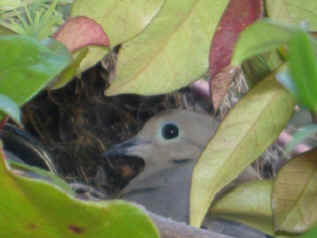
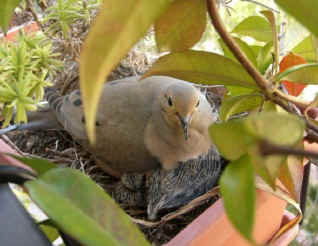
Mourning dove incubating eggs AppearanceMourning doves are about 12 inches in length and weigh about 5 ounces. They have a gray to tan coloration with black spots on their wings and white feather tips. The adult male's head has a bluish tone and the female's head had a brownish color. The neck feathers of the male are purplish, gold, metallic, iridescent. The female's neck is mostly brownish in color. Colors vary and there sometimes all white birds can be found as well as those that are very dark gray. RangeThe mourning dove is found throughout North American from just over the Canadian border down to Central American, Cuba, and Panama. It is considered to be one of the most abundant birds in the United States.. MigrationThe mourning dove is a migratory species. They stay the winter in the Southern United States and Central America and fly north in April and May. Flocks of immature birds form in August and then they fly south in the latter part of September and October. However some birds will over winter in the mid latitudes, staying near creek bottoms and rivers near fields that were used to produce grain in the summers. Other birds that feel they will have a good source of food and water through the winter may choose to stay in northern climates and brave the snow and the cold.
Mourning dove sitting on new babies HabitatThe mourning dove is a characteristic edge species, occurring in largest densities in pine plantations, shelter belts, and fence rows. They also are found in residential settings where the make their nests in ornamental trees and on buildings. They prefer open areas for feeding where seed can be found on bare ground and the also like to be near a water source such as a stream, pond, or river. In recent times there seems to be a movement of dove populations from farmlands to suburban areas. Mourning doves seem to thrive on back yard feeders and also seem to like to build nests on or very close to human habitation. It almost seems like they believe being close to humans offers some protection from their natural predators. FoodThe mourning dove's food is predominantly seeds of cultivated crops such as corn, milo, wheat, sorgum, millet, peas, etc. Weed and grass seeds are eaten when cultivated crops are not available. The doves always eat their food from the ground; they normally never peck it off a plant. I have seen doves eating pine seed that had been dropped out of helicopters for direct seeding purposes on national forest lands and Goodwin reports that mourning doves have been seen eating pine seed out of cones still on the tree. NestingOnce a pair of mourning doves have located a nest site, they will construct a nest made of twigs and sticks in a tree or sometimes on the ground. As mentioned above, a nest is often made in flower plots or planters on the patios, decks, porches, and balconies of human residences. Doves often look for nest sites that have over hanging roofs, both to protect them form the weather and to keep the nests out of the sight of high flying birds such as crows or hawks. Two white eggs are laid, about 48 hours apart, once the nest is complete. Sometime the doves leave the first egg uncovered until the second egg is laid, but usually they will cover it because this keeps it invisible from predators. If the doves are scared away from their nest by human commotion, they will usually return once things quiet down.
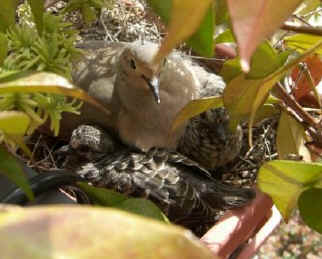
Mourning dove with babies Eggs are incubated for 14 to 15 days. The female doves sits on the eggs at night and during part of the day. The male dove stands guard at night, often some distance away. During the day the male relieves the female so she can defecate, eat, and drink. Toward the end of the 14 day incubation period, both parents often incubate the eggs together to provide additional heat and humidity. After hatching, the young are first fed "pigeon milk" from the lining of the parent's crop, and later they receive partially digested food from the parents. Somewhere between 11 and 14 or more days after the babies hatched out the parents will leave the nest. Within a half day after the parents left, the chicks will become hungry and one by one they take their first flight to the ground, often far below. The parents usually remain out of sight until the babies are on the ground then they will feed them. During the next few days the parents watch over the babies trying to protect them from predators as they improve their flying skills and learn to peck seeds on the ground.. The parents will also continue to feed them up to another 12 days after they left the nest. During that time the parents may rehabilitate their old nest and lay another clutch. Meanwhile the babies will stay nearby several more days unless frightened away.
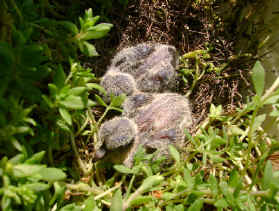
Mourning dove with bigger babies It takes a pair of mourning doves on an average of 33 days to raise a brood. They will make 5 or 6 attempts and of those attempts they will have 3 to 4 successful broods. From the 6 to 8 eggs that are laid they will raise 5 to 6 young birds. Mourning doves do suffer a high mortality and studies have shown that between 50 and 70 percent will die within one year after hatching. Some reports indicated that hunting mortality is insignificant and others indicate that hunting is responsible for taking the lives of 15 percent of the birds each year. While morning doves are one of the most abundant birds in the United States, data indicates that population levels are decreasing. WHEN DOVES NEED ASSISTANCENesting Problems in Residential AreasMuch of the correspondence received on this site is related to mourning dove nesting and the care of "abandoned" mourning dove babies. As mentioned above doves often look for nesting sites on or near human residents apparently with the belief that such sites will offer protection from predators. While many doves will establish their nests in trees and shrubs around suburban residences, others will look for sites such as planters, flower boxes, and flower pots. They prefer pots that are about half full of earth and are located underneath a porch or deck roof. Sometimes they will look for pots located on balconies of hi rise apartments. If you are are providing a pot for a dove and it is in not under a roof where it would be protected form rainfall, it should be only half filled with a very well drained soil or better yet twigs and straw so when it rains the water will drain out immediately. Although doves like to find their own nesting material you may want to help and provide small twigs, grasses, pine straw, etc.
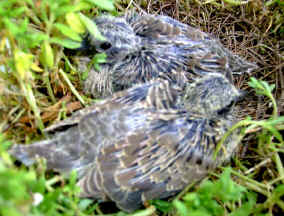
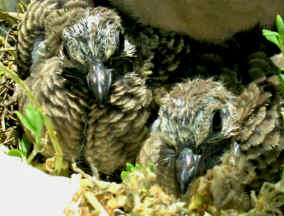
Mourning dove babies just before fledging Thus if there is a heavy rain, the eggs will stand a better chance of remaining above any water that collects in the flower pot. The dove can easily keep the eggs dry from water falling form above, but they are helpless against water that collects underneath them. In fact in this situation doves often will try to move their eggs to a new location. They do this by making a small hole in the shell so a little egg yolk comes out and hardens. Then using the hardened protrusion, they can pick the egg up and fly it to a new location. Another problem concerning
mourning dove nests is the
buildup of a population of external parasites such as lice and mites. Birds that
are being kept as pets can be dusted with 5% Sevin
dust to control these populations and the dust can also be applied to the
nests. When the wild doves leave their nest, Sevin 5 dust can be applied to
the nest to kill any remaining lice or mites.
If the doves were successful in raising their
babies they will probably return to repair the nest and raise another clutch. People ask about providing food and water
near the nest site. It is generally recommended that if food or water
are provided, it should be done far from the site - perhaps on the opposite
side of the home. Food and water located near the nest may attract other
predators. Other times doves will not select the most
ideal nest site and sometimes will place their nesting
material on window sills and other outward sloping ledges that provide a very insecure base.
Thus sometime after the eggs have been laid, the nest and eggs will fall to the ground.
Undamaged eggs can often be picked up and placed in some kind of nest
container located in a more suitable location as long as it is not too far
away from the original nest. Often the parents are slow to come back
to their eggs, but by nightfall they usually come around. To avoid having nests located in
undesirable situations, home owners can assist doves by
leaving vacant flower pots in suitable locations (i.e. under a roof where
the nest can not be seen from above). They can also construct nest
containers that can be attached to trees close to their home. The
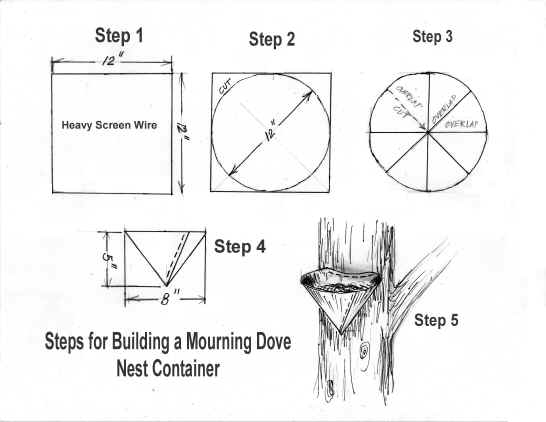
method of making a nest container is described further down this page. Home owners can assist doves in nest building by constructing a nest
container as outlined below and then either attaching it to a nearby tree or to a house.
1. Obtain a square foot of construction cloth for each nest to be made.
2. Cut a circle out of the cloth having a six inch radius
3. Make a six inch cut from the
outside edge of the circle to the center of the circle.
4. Form a cone with the circle, overlapping the
3/8th of the circle, and fastening the edges together with staples.
5. Mount the cone on a tree or building with roofing nails, staples, or wire.
Modify the shape as needed so the cone will stay upright when attached to
the tree. Turn down the edge of the cone so it is rounded and there
will be no sharp ends that would injure the parents or their baby birds.
If possible locate the container where it is shielded from the elements and
would not be visible by a hawk flying overhead or a crow flying nearby.
6. You might also put a few sticks and twigs inside the cone and then let the birds do the rest.
Some people have purchased small wicker baskets for nest containers and wired them to trees or other appropriate locations. If you want to go further you could also provide a bird feeder and a water source but do not place these items near the nest as they may attract predators.
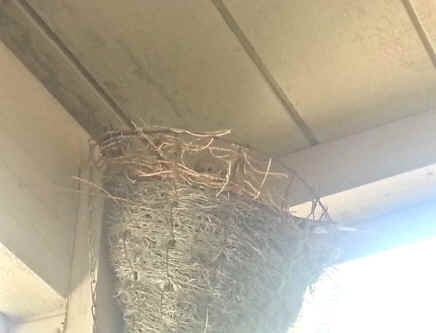
Mourning dove in a conical nest - look closely Angie Ross, who lives near Fresno, California, constructed this nest because blue jays and other birds were bothering the doves that had been nesting on the top of her air conditioner for years. Once the nest was in place the dove quickly saw the advantages of the location and soon moved in. The location is ideal because the roof over the nest protects the doves from wind and rain and in addition the nest is invisible to high flying birds like crows, jays, and hawks. Even from below or from the side the doves can hardly be seen because the nest is so close to the roof. The only disadvantage of a nest like this that I can see is that one would not be able to get good photographs of the doves and their babies. But I think the doves would give the nest site a A+++ rating. The Migratory Bird Act and Other RegulationsThe following sections involve activities that may be in violation of the Migratory Bird Treaty Act of 1812, its several amendments, and associated state laws unless the necessary permits area obtained. In general the act prohibits the taking, killing or possessing migratory birds listed. See the federal Fish and Wildlife Service's web sites for additional information or contact a U.S. Fish and Wildlife Service office. You also may want to contact your state department of natural resources office. I offer the information below as I believe the act's intent is to protect bird populations and that by saving a birds life one is conforming to the spirit of act. Law enforcement personnel or a judge may or may not agree. Moving An Existing Nest to a New LocationA number of people have written in about their need to move an existing nest containing eggs or babies to a new location. Usually this happens with the doves select a nest site near or on someone's home and repairs to the home are scheduled before the eggs hatch and the baby doves fledge. And even if the babies do leave the nest before the repair work is to start, the doves will often return within a week to start the next clutch. Permits can be obtain for moving nest from one location to another. Wildlife professionals are against moving birds any distance form their original location because it disrupts the birds life in its established territory. It is also harmful to the birds because even if they are moved, when they return from the next year's migration, they will usually return to their original location. Moves on one's property for short distance should not be a serious problem if done according to the directions below. If you are moving a nest, try to select a location that is not too far away from the original location. The first step may be to fashion a nest box or container out of construction cloth. In the morning carefully move the nest from its current location and place it in the nest container you constructed and return the nest container to its original location and fasten it down using staples or other means. Of course take care that the eggs are not disturbed or the babies do not fall out. If the parent (probably the hen) does not fly, it may be best to carefully lift her out of the nest and then surely she will either fly are stand close by. If you leave her in the nest she my decide to fight you and the eggs may be damaged as a result or the babies may be dumped from the nest. Leave the nest alone with the eggs or babies and watch to see if the parents come back. They usually will return by nightfall if not much sooner. But it is best to do the change in the morning so the eggs or babies will not cool too much as they would if they were left alone overnight. Do not be afraid of handling the babies if they fall from the nest and need to be replaced. Human scent on the babies or eggs is not an issue If the parents do not return, then you can determine if you want to turn the babies over to a licensed wildlife rehabilitator or try and incubate the eggs and raise the babies yourself. Directions are given for these procedures toward the end of this page. If the distance between the original nesting site and the old site is far, you might consider making one or more intermediate moves so the parents can easily find the new nest waiting a few days between each move. One person wrote in after she moved a nest from an apartment hallway to a new location because of impending construction work. The doves had found a location above a light fixture that not only protected them from the weather and predators, but also had the benefit of the heat from the light bulb. Now wild doves usually have lice or mites under their feathers especially when the dove are incubating their eggs and they fluff to maintain a higher than normal body temperature. But in this situation, the mites and lice on the dove in the nest had multiplied an unusual level. The woman wrote to me complaining that when she took the nest down, the mites ended up crawling all over her arms and she said I needed to warn people against these parasites on my web site. There is now a cautionary statement in bold print toward the end of this page. If your are concerned about these parasites, a few days before moving the nest you might consider obtaining and applying 5% Sevin Dust to the nest doing your best to keep it away from any babies that may be in the nest. The dust should not hurt the birds if it is kept away from their eyes. ears, and beak CAUTION: It should be noted that mourning doves, their babies, and nests often become infested with various parasites including lice, mites, fleas, and ticks. While their parasites can not live without birds, they can still get on human bodies and could live as long as three months before dying. To avoid contacting these parasites, a insecticide like Sevin 5 which will not harm the birds, should be applied to the nest during construction, during the occupancy period if possible, or before you remove an old nest or recondition it for future use. Then leave the nest alone for a couple of days until the parasites have been killed or have left the area. When You Find a Fallen Baby Dove...In the spring and summer months many people will come across baby birds that have fallen from their nest or in the case of older birds may have flown to the ground for the first time and are being watched over by the parents. I have divided the babies development into three groups based on the average number of days after hatching. In actuality of course the doves gradually evolve from being un-feathered when they hatched out to being fully feathered when they fledge (leave the nest). Un-feathered Babies (0 days to 6 days)
It is unusual to find an un-feathered baby dove on the ground. This might occur if the nest falls from its location due to high winds or other adverse weather conditions or the parents may have perceived the baby to be defective in some way and had thrown the baby out of the nest. Often the cause only is the baby is too weak to hold its head up to feed. Hand feeding for a day or two can often overcome this problem. Often the baby can then be returned to the nest. Un-feathered babies will die quickly if they are not kept warm. If you can locate the parent's nest, you should try and return the baby to the nest and then watch to see that the parents return before the baby gets too cold. Otherwise the baby needs to be put in a nest box with nesting material located inside a much larger box. A lamp with an adjustable arm can be used to maintain the temperature of 94 to 96 degrees F. If you find a baby on the ground that feels very cold and lifeless, you may be able to bring it back to life by holding under in your hands under warm water running from a faucet and adjusted to be a little warmer than human body temperature (106 degrees F). This may take several minutes. Once the baby is fully warmed he can be easily dried with a soft paper towel and then placed in a warm nest box. If you do not want to be involved with the work of raising a small baby dove (it is a very time consuming process), the bird should be taken to a licensed wildlife rehabilitator or a wildlife rescue organization. If you can not find contact information you can usually contact local veterinary offices and many will accept such birds and take care of them until they can be passed on to the appropriate organizations. Doves less than seven days old are usually fed crop milk by their parents. The best formula to use for babies found during these first days is Roudybush's Squab Formula. See the section near the end of this page for more information regarding the emergency feeding of doves. Partially Feathered Babies (7 days to fledge (12-15 days))
It is even more unusual to find a partially feathered dove on the ground. This usually only happens when a nest falls apart due to poor construction or because of a severe storm. If the nest has been destroyed you should try and construct a new nest for the babies. This can be done by using construction cloth (wire screening) as illustrated in an earlier section on this page. The cone that is formed with the screening material should be filled with nesting material that is porous enough so rain water will run right through and not collect in the nest. Babies can be placed in the nest and then again you can watch for the parents to return. If they do not cover the baby by nightfall you may want to take them inside to keep them warm and then return them to the nest in the morning. Otherwise the baby needs to be put in a nest box with nesting material located inside a much larger box. A lamp with an adjustable arm can be used to maintain the temperature of 85 to 94 degrees F depending on how well the body is covered with feathers.. See the section below regarding the emergency feeding of doves Fully Feathered Babies (fledge to self sufficient (12/15 days to 20/30 days))
Careand Feeding of Baby Mourning DovesYoung baby birds without feathers need to be kept warm. We have placed birds under a table lamp with an adjustable arm in a box lined with soft paper towel covered with nesting material and vary the lamp's height to keep the temperature around 95 to 97 degrees F (2). If you are able to obtain baby bird formula, the best kind to get for doves is Roudybush's Squab Formula. Pet stores usually do not carry it but it can be obtained from the Roundybush web site (www.roudybush.com). Kaytee's Exact can also be used and is available in most pet stores but it does not result in the best growth rate. If a pet store is not available you can also use Gerber's Hi Protein Baby Cereal mixed with water. This cereal is available at most supermarkets. Be sure the food is supplied at a temperature a little warmer than human body temperature (105 degrees F) otherwise the baby will show little interest in the food. Food should be provided at least once every couple of hours (day and night) depending on the baby's age. Look at the bird's crop to see when it is almost empty as a guide for providing additional food. (The crop is a sac located on the front of the bird's throat). You can use a syringe to put the food in a bird's beak, but we just put the food in a small spoon. You should not give the young bird any water as he obtains sufficient liquid from the formula. The approximate portions of formula and water are given in the table below. But always check the directions provided on the formula container. I do not have any measure to provide for the use of Gerber's Hi Protein Baby Cereal. Just remember that the formula must be thin and runny for the first days but must be gradually thickened or the proper growth will not occur. If the formula runs through the crop very quickly then the formula needs to be thickened. When the feeding becomes less frequent than three hours, bird seed should be added to the diet. I have always used finch seed for wild birds. This seed can usually be purchased from big box stores like Lowe's or Home Depot in five pond bags.. You may be able to mix it with the formula you are using. However lately I have found once the bird is ready for seed, he or she will often refuse the formula. Then one must open the bird's beak and drop some seed inside. To open the beak I use my fingernail or apply gentle pressure with two fingers, one on each side of the beak. I then pick up seeds with three fingers of my other hand and pour the seeds into the open beak. The bird's head can then be released so he can swallow the seed and the process can then be repeated. I hold the bird over a small tray so I can collect the spilled seed. You can also try using a syringe where the tip has been cut off at a diameter that will allow the seeds to pass through the opening. Or you can completely cut off the nozzle of the syringe, insert seed, and then wrap a small piece of cloth around the opening using tape. Make a hole in the cloth for the birds beak. Others put the seed in the finger of a rubber glove and get the bird to get the seed by pushing his beak through a hole in the tip of the finger of the glove. Getting a bird to eat seed for the first time is difficult, but once you find a way that works for you, repeating the process becomes easier. APPROXIMATE BABY MOURNING DOVE FEEDING SCHEDULE
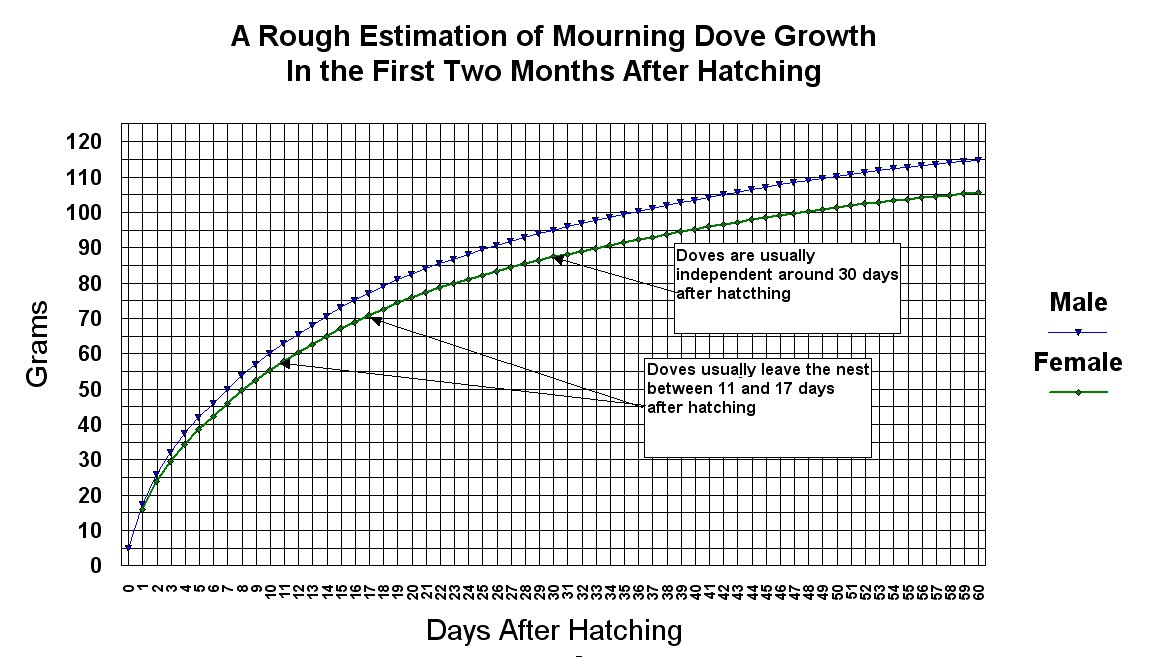
* Roudybush Formula 3 (1) (2) (4) (5) As the dove becomes fully feathered, the temperature can be gradually reduced to the high 80's. The baby should be ready to leave the nest between days 11 and 17 and should begin to fly at that time. Then the biggest problem is then to get the bird to peck seeds on his or her own. Be careful, because often the birds will peck seeds, but not roll them up inside their beaks. Watch the crop to see that it is nearly full after they eat and if not then provide supplemental feeding. While you may let the bird go a day without hand feeding to encourage the bird to peck and swallow seeds be careful that he does not loose a significant amount of weight. Diamond doves as well as other dove species may serve as a teacher for pecking seeds if they are available. Birds should only be released after they have learned to peck seeds on their own and have become strong fliers and capable of making accurate landings. Mourning Dove Age / Weight RelationshipsMany people write in and ask about the weight of a mourning dove they have and if the dove they have rescued is growing adequately. These curves display a rough approximation of dove age vs. weight. If you copy and print out this graph you can plot your dove's weight over his estimated age for several days. If the slope of your data is the same (parallel) as the slope of the graph data then his growth should be considered adequate. It should not matter if your curve is higher or lower than the graph curve because you probably do not know the birds hatch date. (These curves were developed from a number of data points written in various research papers)
Some Thoughts Concerning the Release of Baby DovesIn the wild, mourning doves leave the nest around 15 (11 to 17) days. But the father continues to feed and care for them until they are about 30 days old. (Meanwhile the mother goes back to the nest to start the next clutch). During this time the father teaches them how to peck seeds on their own, watch for, hide from, and escape predators, and how to find safe roosting perches at night. Before release, the fledglings should have strong flight capabilities. The only way I know of to judge their flight capabilities is to allow them to fly around a large room in your home (with mirrors and windows covered and protection provided against sharp objects. Overhead fans should be turned off). The doves should be able to take off and land without difficulty and fly up rapidly to be able to get away from predators, The doves should have these capabilities by the time they are 30 days old unless they were injured. If new feathers had to grow out as the result of the injury, they should not be released until 30 days after new feathers started growing in. Many wildlife rehabilitators believe the doves should be released close to your home so they know where to return if they run into problems. Take the doves outside in a cage for a number of days before release so they are familiar with the neighborhood. It is probably a good idea to release a dove early in the day in case it does want to return by night fall. Some released doves will go out during the day and then return to the caretaker's home in the evening for a number of days before they decide to go out on their own so be sure to check outside around dusk to see if your dove wants to go inside. You might want to put out a feeder for doves (safflower seeds) to attract the local flock to the area. In many cases the released dove will join the local flock which will aid in the doves' adjustment to life in the wild. Sometimes released doves are attacked by predators weeks or months after they have been released. If they are hurt bad, they may well find their way back to your doorstep, so it is a good idea to be aware of that possibility. One woman found her released dove on her doorstep several months after being released, wounded and bloody. She took him in and took care for him for a month or so. When she went to release him again he flew away from her, did a u-turn and went back in the open door and from then on refused to go near the door... Even after some time has passed, a released dove will often return to say "hello" and perhaps even bring back a new mate with him or her. And if you provide a planter or hanging flower pot suitable for nesting they may decide to raise a new family adjacent to your home. And when birds migrate south in the winter, they will often find their way back to their nest year after year. Care of Injured Adult Mourning DovesThis is the only place on this web site where we address the care of a wild bird. Normally we would suggest that any sick or injured wild dove be immediately turned over to licensed bird rehab person as taking mourning doves in would be in violation of the Migratory Bird Act of 1918. But during the past few years several people have written in requesting this information as they were unable to find an official organization to take the doves and they could not see allowing the bird to die by not caring for it. The most common injuries to wild doves are caused by predators such as cats, dogs, crows, jays, and hawks. Sometimes injuries area caused by flying into windows where they are confused by he reflections of trees and sky, or into wires. When a dove is injured by colliding with a window, it often is just stunned and warmth, rest, and food is the only medicine that will be needed for recovery If you find an injured wild dove approach it slowly and pick it up. If it moves away consider throwing a towel or other light material over the bird to facilitate picking it up. Examine the bird for bleeding and other serious wounds. Surface wounds will heal quickly if properly treated. Use pressure over gauze to stop the bleeding. Then the wound should be cleaned with soap and hot water after the bleeding stops. Hydrogen peroxide can be applied to the wound. Use tweezers to remove dirt other foreign particles. Clean the wound daily and reapply the hydrogen peroxide. If the bird has puncture wounds or if the wounds are large enough to require stitches then you should contact an avian veterinarian as soon as possible. Keep in mind that a dove has a very limited blood supply so it is essential to stop all bleeding as soon as possible.If the bird has been bitten by a
cat it should be taken to a avian veterinarian for an antibiotic shot as cats
have certain bacteria in their mouths that are lethal to doves. The dove
may seem to be recovering nicely but in about three days it will die suddenly. For information about other
injuries and sicknesses see the Care of Sick and Injured Doves page of this web
site by selecting the page title from the left side menu. Although that
section was written for pet birds much of what is written there also applies to wild
doves. Once the bird is stabilized it should be kept in a
"hospital cage environment" until it recovers. A large cardboard
box lined with a soft towel can be used. If the bird can perch, then a
half inch dowel or heavy tree branch can be placed in the box. The
temperature in the box should be kept between 85 and 95 degrees F by using a 100
watt lamp or heating pad. For food you can provide wild finch seed or
other seeds for wild birds that include doves. Water can be placed
in a heavy glass flan container so it will not tip over. Once an
injured dove seems to be recovered allow them to fly around a large room in your home (with
mirrors and windows covered and protection provided against sharp objects.
Overhead fans should be turned off). If he can manage take offs and
landings without crashing for a few days then I would suggest releasing him in
the morning of the next day. CAUTION: It should be noted that
adult mourning doves may become infested with various parasites
including lice, mites, fleas, and ticks. While these parasites can not
live without birds, they can still get on human bodies and could live as
long as three months before dying. To avoid contacting these
parasites, a insecticide like Sevin 5, which will not harm the birds, can be applied to the
dove's body (avoid eyes, ears and beak) and the floor of the cardboard box.
You can also obtain sprays for birds from pet stores. Emergency Egg IncubationSome people have sent in messages asking about what they can do if the parents abandon what appears to be a perfectly good clutch of eggs. If the parents do not return to their nest within a day or two, I have taken the eggs and put them in the nest of another pair, and often they will sit on the eggs, and if they hatch, the foster parents may raise the babies. If they refuse then we have taken over the feeding process and have successfully raised a number of babies ourselves - we have also lost a few. If you do not have any foster parents, you might attempt incubating the eggs. I have never had reason to do this my self so the following is not based on personal experience. Danny Brown (1) in his book "A Guide To Pigeons, Doves, and Quail" recommends a temperature of 100 degrees F (37 degrees C) and humidity levels between 55 and 60 percent. A thermometer and hygrometer are necessary for the accurate measuring of temperature and humidity. If you have a poultry incubator it can probably be set to these settings. Otherwise the eggs need to be placed in a box with a lamp that can be raised or lowered for temperature control and one or more bowls of water for humidity control. The eggs need to be placed in an egg carton or something similar and stood up so the narrow tip is pointing up and the axis of the eggs is leaning against the side of the egg carton at about 45 degrees. The eggs should be rotated 180 degrees left to right in the morning and 180 degrees right to left at night. Incubators may turn eggs up to 25 times a day but it is felt that turning them twice a day may be adequate. Danny Brown (2) maintains that egg turning is essential for the normal growth and development of the embryo. For most of the incubation period one has only to pay attention to the maintenance of temperature and humidity levels and egg turning. But 48 hours prior to the expected hatching the eggs should no longer be turned and the humidity should be raised to 70 to 75%. Birds often obtain the increased humidity by double nesting during the last two days WARNING: Possession of mourning dove eggs without a federal permit is prohibited by the Migratory Bird Act of 1918. References(1) Baskett, Sayre, Tomlinson, and Mirarchi, Ecology and Management of the Mourning Dove, Harrisonburg, PA, 1993, pp. 567 (2) Brown, Danny, A Guide to Pigeons, Doves & Quail, Their Management, Care & Breeding, South Tweeds Heads, Australia: Australian Birdkeeper 1995, pp. 184
(3) Gibbs, David; Barnes, Eustace; Cox, John, "Mourning Dove," Pigeons and Doves, A Guide to
the Pigeons and Doves of the World, London: Yale University Press 2001, pp. 320-322 (6) Miller. Wilmer J. PhD, "Mourning Doves" A presentation to a public forum on "Should Doves be Hunted in Iowa" sponsered by the AMES Audubon Society (7) Vriends, Matthew M., PhD., "Mourning Dove (Zenaida macroura)," Doves, A Complete Pet Owner's Manual. Happauge, NY: Barrons Educational Series, Inc., 1994 , pp. 85-87
©2014 - Helen White
Last revised on January 1, 2014: |
||||||||||||||||||||||||||||||||||||||||